Showing posts with label Evangelism. Show all posts

Thursday, March 20, 2008

Hudson Taylor-- Faith

Background Check:
England in the 1800s was the most powerful nation on earth. It was said that “the sun never set” on the British Empire—and it is true that their Empire stretched all around the globe. And Queen Victoria was their glorious monarch who emphasized that discipline, authority and strict morality was the way to retain control over the world. Everyone in England was Christian, in one way or another, and the brand of Christianity that was accepted by most was one that upheld society and discipline in every way.

Christian England in the late 1800s had a powerful urge to declare the gospel of Jesus. After centuries of war, debate and reform about Jesus and the Bible, the church there decided that it was their responsibility to share the good news with the heathen of foreign lands. Declaring the news of Jesus to those who do not believe in him in foreign lands was called “missionary work” and the groups that sent out these “missionaries” were called “mission societies”. Mission societies had strict guidelines for what kind of people would be sent by them to heathen lands. These missionaries had to be upstanding citizens, in excellent health, typically married and strictly loyal to England.

His Story:
A man by the name of Hudson Taylor approached the mission societies in London, desiring to be sent to China. He was a man who was sick from birth and never completely overcame his illnesses. He was a man who had little money, but believed firmly that God would provide. He was firmly convinced that God had called him to go to China to teach about Jesus. And he had a new idea—instead of focusing on the coastal cities of China, as all missionary societies had done, they should take the gospel to where it had never gone before, to the inland of China.

Hudson Taylor went to many missionary societies. And he was rejected by all of them. “He is too sickly” some said. Others said that his ideas were too outlandish. And others felt that they would declare him worthy to go to the mission field, not a voice speaking in the missionary’s head. But Hudson was determined to do what God wanted him to do, even if no one would send him. So he established his own missionary society, called “China Inland Mission” (or CIM for short). In his society, the only people who would be sent are those who know that God had determined that they would go. In CIM, they wouldn’t wait for the total money to be brought in before a missionary was sent—If God was sending them, God would provide the money in his time. Soon money was gathered for the new society and they send their first group of missionaries to China, with Hudson Taylor at the head.

Hudson Taylor worked hard in China. He focused his declaration of the gospel to those who had never heard it. He learned to speak Chinese like a native and began to teach the Bible to those who wanted to hear something new. Some had trouble accepting the words of Jesus from a “foreign devil” from England—so Hudson changed his appearance so that his clothing and manner of speaking was all Chinese. And he went beyond the coast lands of China and led teams deep into the heart of China. One person who had just heard the gospel recognized the truth of it and said to Hudson, “My father and grandfather sought this truth all their lives and they died without hearing it. Why did you not come sooner?” Hudson Taylor wept at this, but was more determined to have the gospel declared to all people in China.

Hudson soon suffered setbacks. He had many attacks of sickness and often had to be returned to England so that he could be treated by the skilled doctors there. Finally, after many trips back and forth to China, Hudson remained in England to run CIM. He inspired many with his speeches and his outlandish Chinese clothing so that many joined CIM.

WWJD
Jesus insisted that his “missionaries” or apostles would go without anything. They would have to endure through great difficulties and persecutions to achieve their goal of obeying Jesus. The focus was not on success, but on faithfulness to God’s call. This is exactly what Hudson Taylor expected from himself and from his missionaries. Jesus blessed Hudson Taylor’s mission with great success—but not during his lifetime.

The Final Word (of Men)
Because of Hudson Taylor and others like him, China today has a powerful underground church that preaches the gospel of Jesus without any foreign or government influence, even though they are persecuted by the Chinese government. China Inland Mission changed their name to CIM International, still trying to be focused on “faith missions.” However, most missions agencies insist, unlike Hudson Taylor, that missionaries be sent to another country only after they have raised enough commitments that people would sent large amounts of money every month. Missions agencies like Hudson Taylor’s almost do not exist anymore.

A Word From Our Sponsor:
The disciples came to Jesus and said, “Why could we not do this deed?” And Jesus replied, “Because of your little faith. For truly, I say to you, if you have faith as a grain of mustard seed, your will say to this mountain, ‘Move from here to there,’ and it will move. Nothing will be impossible to you.” Matthew 17:19-20

Helpful Hint: Teaching the Truth of Jesus
The church that takes on Jesus’ name has taught many things over the years, from many different sources. However, the Faithful focus their teaching only on what Jesus himself taught. While they may teach other things, Jesus’ teaching is the focus of all that they say and do. Paul was persecuted by the Jews for insisting that Jesus was sufficient. Michael Sattler insisted that the true church is based on the teaching of Jesus and not anything else. John Wesley taught the teaching of Jesus carefully, not allowing it to be made impure by any other teaching. When giving the truth to others, the Faithful are sure that they are speaking the truth of Jesus, not of others.

Check It Out:
Hudson Taylor’s Spiritual Secret by Mr. and Mrs. Howard Taylor

Thursday, March 13, 2008

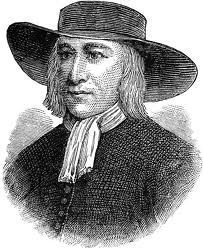
George Fox-- Boldness

Background Check:
The Reformation of the church took place in England, but the transition was complicated and violent. King Henry VIII separated England from the Roman Catholic Church because he did not like what the Roman church had to say about his personal life. And so he began the Protestant Anglican (meaning “English”) church, calling himself the head and taking over all the lands the Roman church owned in England. After Henry died, one of his daughters came to the throne, “Bloody” Mary, who exiled and killed all the Protestants who would not convert back to Catholicism. Then after Mary died, Elizabeth took the throne for many years and made the Anglican church the official church in England.

His Story:
Most Catholics and Jews were exiled out of England at that point, but the Protestants were still not pleased with the church. Many Protestants still felt that the Anglican church had too many aspects of the Catholic church within it. They still performed what looked like a Catholic mass (The Lord’s supper) and they used much of the authority structure, clothing and worship practices of the Catholics. These who wanted the church to be “purified” from Catholicism were called “Puritans” and they were a strong minority voice in the church of England.

In the midst of this conflict came George Fox, an educated young man who had some odd ideas. He received visions and prophecies from God directly to people and spoke these. He studied the Bible continuously, but was confident that his interpretations were correct, while many churchmen were wrong because he was inspired by the Holy Spirit, and they primarily just accepted the views given to them by the schools they had gone to. One thing is clear, though: what George taught was a simple and clear teaching of the Bible, as opposed to the various arguments and confusions that was usually presented as pure doctrine.
George taught that a minister or pastor is not one who is educated at school, but one who is inspired by the Holy Spirit to speak the word of God. He taught that the church was not based in a nation, a building or in outward things, but that the kingdom of God was within one’s heart. He taught that baptism and the Lord’s supper were not important as outward actions, but that the inward baptism of the Spirit and one’s dedication to Jesus is most important. He also taught that the church of God should not participate in war, but to be holy communities in the midst of the disobedient world.

Many who were dissatisfied with the Anglican church’s focus decided to follow George Fox and his new ideas of what the people of God were. They called themselves “Friends” because they were all equal in the sight of Jesus. But those who looked at them called them “Quakers” because many of them would shake when under the Spirit’s influence. After the first five years of its existence, the Quaker church grew to twenty thousand people in England and was growing fast.

WWJD
Jesus taught much like George Fox did: simply, through the Scriptures, and directly confronting the hypocrisy of his day. Jesus did not desire that his disciples be weaklings, hiding from persecution or afraid to speak out. He commanded them to be bold. George Fox depended on Jesus’ Spirit and on Jesus’ word to communicate to everyone the truth of God. That is exactly what Jesus wanted.

Final Word (of Men)
George was remarkably bold in his proclamation of God’s word, directly confronting Anglican authorities as often as he could. The Anglicans were very angry against George and threw him in jail time and time again. They also persecuted the Quakers as a whole and threw many of their poor, rural preachers into jail. But no matter how many times they were thrown in jail, and how badly they were persecuted, George always taught and showed by example how necessary it was to be bold with the word of God—proclaiming the truth of it, even though many who claimed to be of God were opposed to it.

The Quakers (or Society of Friends) still exist today. Over the years, the Quakers in North America created a colony that never attacked the Native Americans (called Pennsylvania) and they were very significant in working toward setting black slaves free.

A Word From Our Sponsor:
"Therefore do not fear them, for there is nothing concealed that will not be revealed, or hidden that will not be known. What I tell you in the darkness, speak in the light; and what you hear whispered in your ear, proclaim upon the housetops. Do not fear those who kill the body but are unable to kill the soul; but rather fear Him who is able to destroy both soul and body in hell. Are not two sparrows sold for a cent? And yet not one of them will fall to the ground apart from your Father. But the very hairs of your head are all numbered. So do not fear; you are more valuable than many sparrows. Therefore everyone who confesses Me before men, I will also confess him before My Father who is in heaven. But whoever denies Me before men, I will also deny him before My Father who is in heaven. Matthew 10:26-33

Helpful Hint: Boldness for God’s Word
The Faithful were not weaklings. Some, like Therese, seemed weak and frail, but they were all bold and forthright about one thing—the word of God and the life of Jesus. These were people who were called by God to show the world what it meant to follow Jesus and they did so with all they had. Paul stood before groups who strongly opposed him and proclaimed the word of Jesus. John Wycliffe publically taught the truth of the word of God, even though the whole world was against him. George Fox stood before whoever would oppose him and would declare the truth of God, even though he knew he would be imprisoned. Not a one of these were wall-flowers. They were all people who stepped out to tell the truth to whoever wanted to hear—and so some who didn’t!

Check It Out:
The Autobiography of George Fox

Patrick-- Sharing the Gospel With Enemies

Background Check:
Europe in the fifth century was a chaotic time. The city of Rome had been sacked by Germanic tribes and all of Western Europe was in disarray. Vikings from the North and Huns from the East came in to attack the peoples there and they often left as quickly as they came. Many people were taken as slaves and no central government existed to protect large groups of people.

His Story:
Patrick was a young Christian of 12 who lived in England, when his family was attacked by a group of Irish marauders. They burned his house, stole his goods and took Patrick as a slave to Ireland. He worked as a shepherd for six years until he escaped and, with the help of a ship’s captain, returned back to England.

In England again, Patrick long remembered his days in Ireland. He remembered his anger and the injustice he suffered. He remembered the people, who were little more than barbarians. But he also realized that much of their roughness and evil ways is due to the fact that no one in Ireland had the gospel. They didn’t know anything about Jesus. And so Patrick made the decision that he would return to Ireland, and tell the people there about Jesus. And he prayed constantly for the people of Ireland, that they might come to know the Lord.

Patrick went to a missionary “school”—which was actually a monastery—for years and then he was ready to go. However, the church in England was reluctant to send Patrick because he didn’t know Latin—the language of the church and the educated at the time. But when their other choice suddenly became sick, Patrick was the only one to send to Ireland, and so Patrick was chosen to go.

WWJD
Jesus and the Holy Spirit put their own approval on Patrick by allowing him to work miracles—such as finding food when he and a group of travelers were starving after Patrick prayed. Patrick did just what Jesus said—he loved his enemies, he preached the gospel to those who did not know it, he made disciples of Jesus wherever he went. It did take him years of maturity to get to maturity in obedience to Jesus, but for Jesus it was worth the wait.

The Final Word (of men)
At first when Patrick taught the gospel, he was rejected by the people. But he remained with these rough people and became their friend. Over time they listened to the story of Jesus and realized that their peace could come from no other than him. Soon, hundreds and then thousands of people would flock to listen to Patrick tell about the gospel. By the time Patrick died, in 461, almost all of Ireland had been baptized and they were now sending missionaries, instead of marauders across the sea to spread the gospel to others.
Patrick and a few others began a new kind of Christianity—Celtic Christianity. It remains to this day distinct from Roman, Orthodox and Protestant Christianity, but it is still a great example of a community of Jesus.

A Word From Our Sponsor:
But I say to you who hear, love your enemies, do good to those who hate you, bless those who curse you, pray for those who mistreat you.
Luke 6:27-28

Therefore do not fear them, for there is nothing concealed that will not be revealed, or hidden that will not be known. What I tell you in the darkness, speak in the light; and what you hear whispered in your ear, proclaim upon the housetops. Therefore everyone who confesses Me before men, I will also confess him before My Father who is in heaven.
Matthew 10:26-27, 32

Helpful Hint: Forgiveness for Enemies
The Faithful loved their enemies, which was radical enough. But even more than that, they followed Jesus’ example in forgiving their enemies and seeking to reconcile with them. Patrick made it his life goal to go back to the people who enslaved them and to bring them the gospel. As we will see later, Peter Waldo sought to reconcile with the Roman Church, even though they were attacking his group. Elizabeth Elliot went back to the very tribe that killed her husband in order to bring them the gospel. Desmond Tutu sought to have the persecuting whites confess their sins and be pardoned. The forgiveness they gave was personal and complete—not just a half-hearted “it’s alright.” They laid down their lives to be reconciled with their enemies.

Check It Out—
Patrick (a novel) by Stephen Lawhead